Hoodie 01 / round two / 5 Aug 2026
Round two
Nothing on the front. One cross on the back.
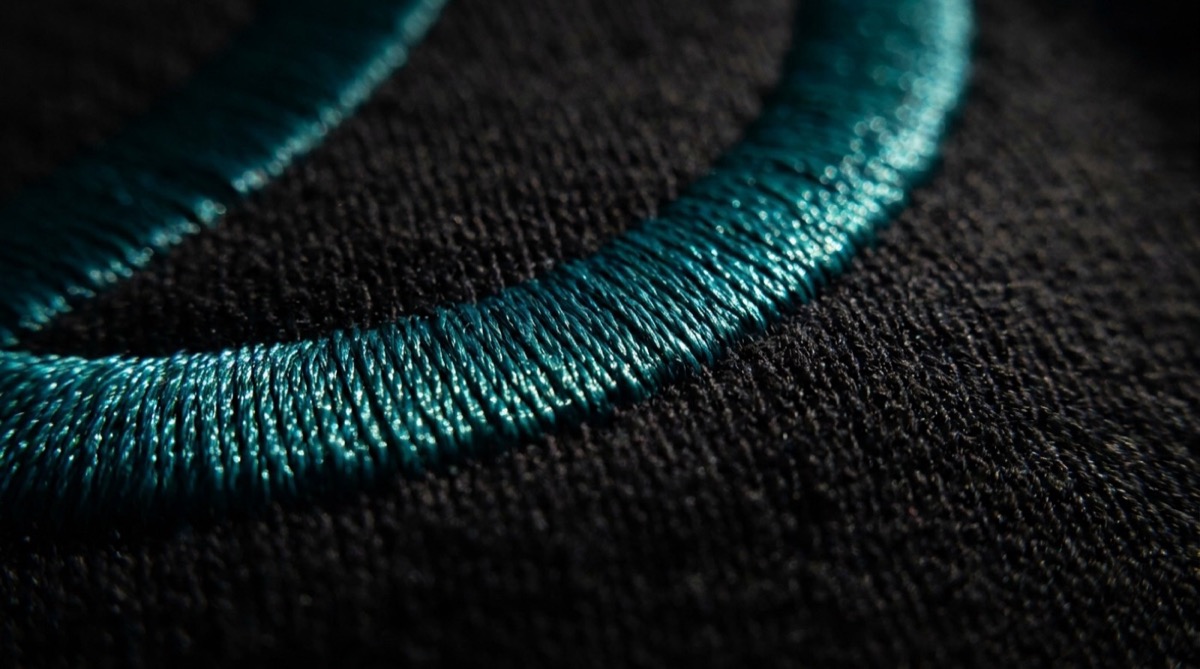
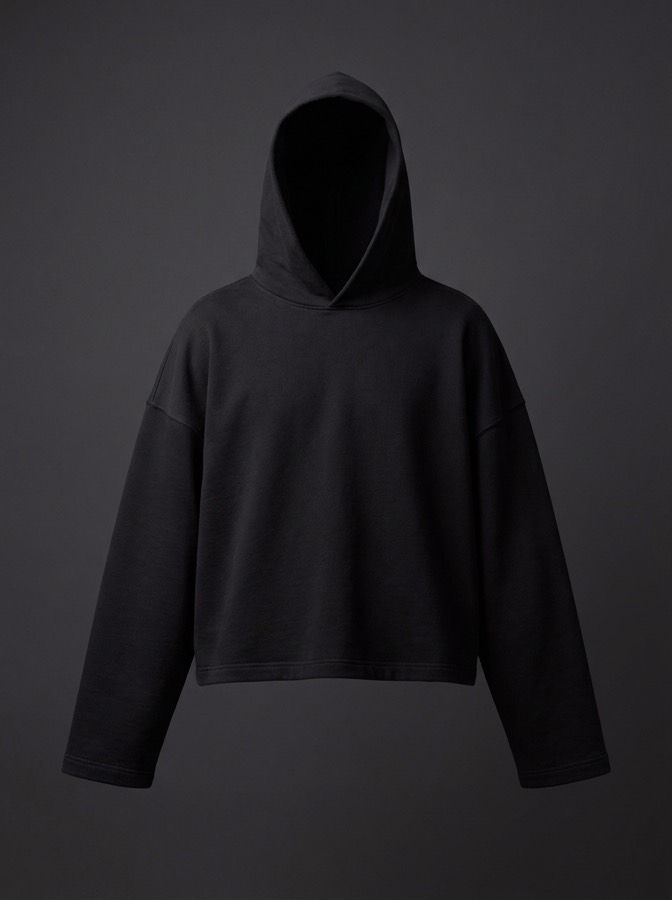
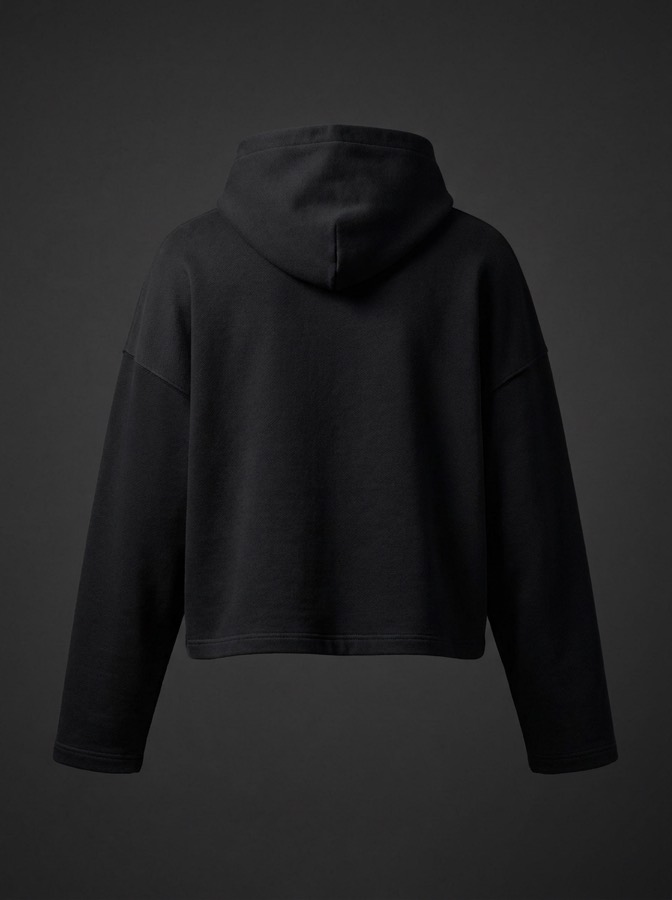
Stitched, not printed. No cords in the hood, no ribbed cuffs, cut square and cropped, in a fabric that hangs heavy and still breathes.
Four changes to the garment
Everything you flagged, and what each one costs you.
Easiest change on the list. Cords get pulled at finishing on a stock blank, or specified out on a custom run. No added cost either way.
This is the expensive one. Ribbing is sewn into a stock blank and cannot be removed. A straight cuff means a custom run.
Wide as it is long, hem sitting high, shoulder seam dropped well down the arm. Squarer than round two. It also means fewer sizes to carry.
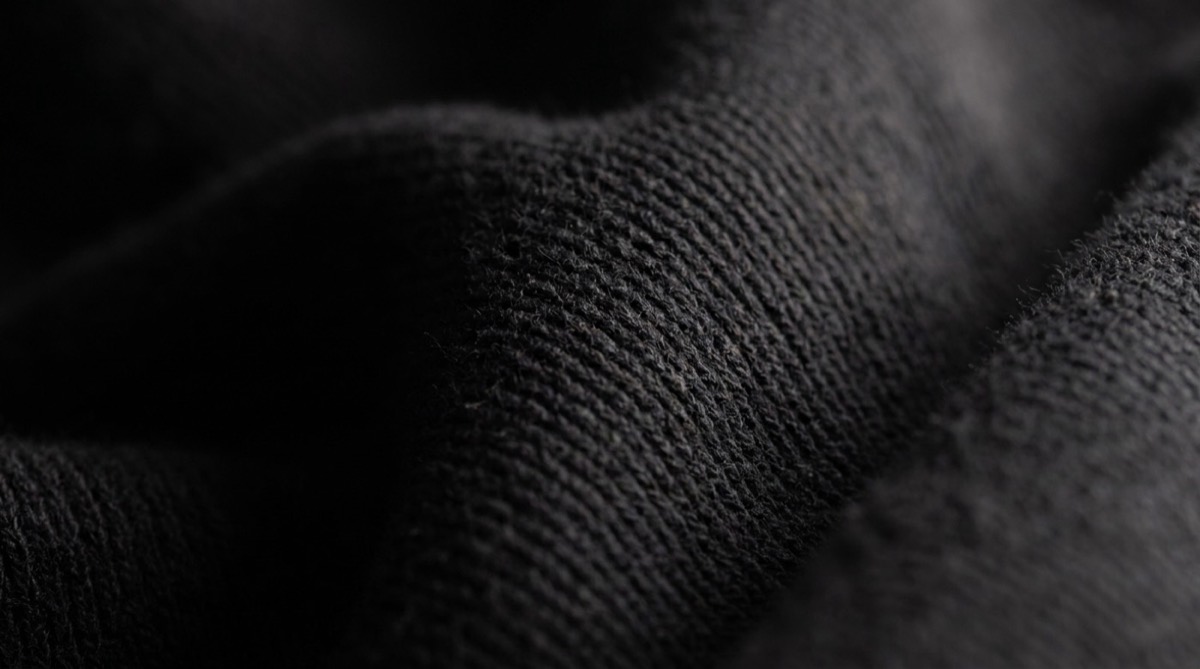
Brushed fleece is what makes a hoodie hot and puffy. French terry is looped inside instead of brushed, so it hangs heavier and still moves air.
The build
Front stays empty. Back carries the whole thing.
Both shots are the new spec: no cords, no ribbing, heavily dropped shoulder, square cropped body. The cross is placed at true size so you are judging real proportion.
Satin stitch
The cloth is painted onto the garment itself, so switching fabric changes the shot. Two honest caveats. The weave is shown larger than life, because at true scale a terry loop is under a millimetre and would be invisible on a photo this size. And the texture only goes on the flat shots, not the worn ones, because the software cannot tell a hoodie from the hair in front of it.
Where the inches and the money come from
Inches are derived, not measured. Every photo here is a render, so the tool assumes the flat body panel is the width you set above and scales from that. Change the number when you have a real garment and everything recalculates.
Costs are published industry ranges, not quotes. Garment and decoration figures come from 2026 supplier pricing guides. Embroidery is priced by stitch count, so the busier marks cost more. Screen print is cheaper per piece but carries a setup charge per colour and does not have the same hand feel. Nobody has quoted your actual spec, so treat the number as a sanity check and go get three real quotes.
Nobody can identify the brand walking toward them. The cheap fix is a small cross in black thread on black fabric at the left chest, the kind you only catch when light hits it. It is costed as its own line below, so if you want the front truly empty you can just delete that line and watch the number move.
How the inches are worked out
Inches are derived, not measured. The photo is a render, so the tool assumes the flat body panel is the width you set above and scales everything from that. Change the number when you have a real garment in hand and every readout updates. The dashed line is the collar seam the vertical measurement is taken from, and you can drag it.
All three fabrics at the same magnification.
The garment shots cannot show you fabric. These can. All three windows are tinted to the body colour you picked and scaled together, so the only thing changing between them is the cloth.
Live notes
See something off? Say it here.
Anyone with this link can post. Notes land here for both of us in seconds, no account and no app. Keep scrolling for the marks, the costs and the spec, and come back to this any time.
Stitched
Thread changes what the mark can be.
Satin stitch sits above the fabric and catches light along the thread direction, so the mark shifts as the wearer moves. Print sits flat and eventually cracks.
It also sets a floor on detail. Thin lines and sharp inside corners do not survive a needle. The solid flared cross is close to ideal. The feather is the opposite, and that changes the answer to the first question at the bottom of this page.
Five marks
Still the open call, now judged as thread.
Same five from round one. What changed is the test: each one now has to hold up as stitching at 7 inches across a back panel.
Full flare
Your original pick. Embroiders cleanly. At 7 inches on a back the barbell read gets stronger, not weaker.
Half flare
Arms wide enough for a clean satin fill, no barbell read. Shown here as thread. Still the one I would make.
RecommendedStraight
Lowest stitch count of the five, so the cheapest to run. Also the most forgettable at back size.
Two tone
In embroidery a second color is a thread change, not a second screen, so it is cheap here. The two colors meet at a hard seam.
Cross and feather
Highest stitch count, so the most per piece. The barbs are the part a needle handles worst.
Costs
Two ways to make it.
The straight cuff is what splits these. Everything else you asked for is available off the shelf.
Buy a finished blank, pull the cords, embroider it. Fast and cheap to test. You keep the ribbed cuffs, so it is not quite the garment you described.
Roughly $1,000 to $1,540 to get 24 units in hand.
Made to your pattern. Straight cuff, no cords, your fit, your fabric weight. Minimums in Los Angeles average 100 pieces per colorway.
Roughly $6,300 to $10,600 all in, including one time sampling.
| Line item | Path A, 24 units | Path B, 100 units | Note |
|---|---|---|---|
| Garment | $30 to $44 ea | $28 to $35 ea | Path B is barely more per piece once you reach 100 |
| Back embroidery | $10 to $30 ea | $10 to $30 ea | Published range for a full back design |
| Tonal chest cross | $9 to $14 ea | $4 to $6 ea | Optional. Drops hard with volume |
| Digitizing | $40 to $100 once | $40 to $100 once | One file, reused on every future order |
| Pattern and samples | none | $2,500 to $4,000 once | Two or three sample rounds is normal |
| Straight cuff | not possible | included | The whole reason Path B exists |
| Landed per unit | $42 to $64 | $38 to $66 | Excluding the optional chest cross |
Every figure above comes from published 2026 supplier pricing and industry cost guides, not from anyone quoting your actual spec. Heavy French terry, a straight cuff and a 7 inch back embroidery will all move the number. Get three real quotes before committing, and ask each one whether the sample fee credits back against the first production order, because some do and most do not.
At roughly $50 landed, standard apparel markup puts this between $100 and $125 retail. That is a fair price for a heavyweight embroidered piece, but it is not an impulse buy, and it is better to know that now than after you have paid for samples.
Production spec
What a factory needs from you.
| Item | Call | Detail |
|---|---|---|
| Fabric | French terry, 100% cotton | 14 to 16 oz, 450 to 500 gsm, loopback not brushed |
| Fit | Boxy, cropped, oversized | Heavily dropped shoulder, square body, high hem, straight sleeve |
| Hood | No drawcord, no eyelets | Plain finished hood edge |
| Cuffs and hem | Straight, no ribbing | Clean turned hem at sleeve and body |
| None | A kangaroo pocket breaks the flat line front to back | |
| Body color | Black | One colorway for the first run |
| Decoration | Embroidery, satin stitch | No screen print anywhere on the garment |
| Thread, teal | Match to Pantone 3255 C | Approx #35D2CB, unverified, see the note below |
| Back placement | Cross, centered | 7 in tall, top edge 6 in below the collar seam |
| Chest placement | Optional tonal cross | 2 in tall, black thread on black, left chest |
| Neck label | Woven, inside | Wordmark and 2 Cor 5:7 live here now |
| Sizes | S through 2XL | Oversized cut, so most people take their normal size |
Pantone 3255 C is matched by eye to a phone photo of Brooklyn's business card. A photo of a screen is not a color source. Pull the original artwork before ordering thread, or have the factory match to a physical swatch you both sign off on.
For we live by faith, not by sight.2 Corinthians 5:7
With the cross on the back and the front left empty, there is no home for the wordmark or the verse on the outside of the garment anymore. Both move to the inside neck label, which is also where a name change costs you nothing.
Open calls
Three things to settle with Brooklyn.
Feather or cross on the back?
The feather is the more distinctive asset and it is Brooklyn's own hand. Embroidery pushes the other way, since barbs and thin lines are what a needle handles worst. If the feather leads, it has to be redrawn as a solid shape first.
Test cheap, or build it right?
Path A puts 24 units in your hands for about a thousand dollars with the wrong cuffs. Path B is the garment you described and runs six to ten thousand. Most brands do A first to find out whether anyone buys, then spend on B.
Empty front, or tonal cross?
An empty front is the stronger look and the cheaper garment. A black on black chest cross adds four to fourteen dollars a unit and lets people recognize the brand head on. No wrong answer, but it changes the quote.
Round one is still up if you want to hold the printed version next to this one. The five marks have not changed, only what they are being judged against.